
Creating a bespoke commercial play area is a high-stakes investment that requires balancing safety, aesthetics, and community engagement. According to recent industry analysis, over 60% of public play space failures stem from initial design oversights rather than maintenance issues. This statistic highlights the critical importance of getting the foundational design right from the start. When developers, councils, or private entities overlook key operational and inclusive design principles, the result is often underutilized spaces that fail to deliver the promised return on investment. This guide details the most frequent pitfalls in bespoke play design and provides actionable strategies to avoid them, ensuring your project stands the test of time. (Contact Us Jupiter Play)
The Critical Role of Inclusive Design
One of the most pervasive mistakes in commercial play design is treating inclusivity as an afterthought or a compliance checkbox rather than a core design driver. Inclusive design is the process of creating environments that are accessible and usable by people of all ages and abilities. When designers fail to integrate sensory, physical, and cognitive accessibility from the outset, they create spaces that exclude significant portions of the community. (Jupiter Play and Leisure)
Many commercial projects opt for standard, off-the-shelf equipment that lacks the nuance required for diverse user groups. This approach often results in play areas that are physically challenging for children with mobility impairments or overstimulating for those with sensory processing differences. To avoid this, bespoke designs must incorporate varied sensory inputs, such as tactile panels, auditory elements, and visual contrasts, alongside traditional physical challenges. (Jupiter Play and Leisure)
Furthermore, the layout of the play area must allow for easy navigation for wheelchair users and those with pushchairs. Narrow pathways and abrupt changes in surface level are common errors that render a space unusable for many. By prioritizing inclusive design, you not only meet regulatory requirements but also expand the potential user base, ensuring higher footfall and community satisfaction. For a deeper understanding of these principles, you can explore resources on play England which emphasize the social value of inclusive spaces.
Material Selection and Durability
Selecting materials that cannot withstand the rigors of commercial use is a costly error. Commercial play areas experience significantly higher usage rates than residential gardens. Commercial durability refers to the ability of play equipment to maintain structural integrity and aesthetic appeal under heavy, frequent use. Many developers fall into the trap of choosing visually appealing but fragile materials, such as untreated softwoods or low-grade plastics, which degrade quickly.
Wood, while aesthetically pleasing and natural, requires rigorous treatment and regular maintenance to prevent rot, splintering, and insect damage. In high-traffic commercial environments, untreated or poorly maintained wood can become a safety hazard. Conversely, high-density polyethylene (HDPE) and powder-coated steel offer superior longevity and require minimal upkeep. However, the choice must also consider thermal properties. Dark-colored plastics can become dangerously hot in direct sunlight, posing a burn risk to children.
Another common mistake is ignoring the impact of the local climate on material performance. In coastal areas, salt spray can accelerate corrosion in metal components. In regions with extreme temperature fluctuations, materials must be selected for their thermal stability. Consulting with experts on playground safety standards can provide valuable insights into material specifications that ensure long-term viability.
Navigating Safety Standards
Safety is the non-negotiable foundation of any play space, yet many bespoke projects fail to adequately address fall zones, entrapment risks, and structural stability. Fall zones are the designated areas around play equipment where impact-absorbing surfacing must be installed to prevent injury from falls. A frequent error is miscalculating these zones, leading to insufficient surfacing that exposes users to hard surfaces like concrete or compacted earth.
Entrapment hazards, such as gaps in equipment that can trap a child's head or limbs, are another critical oversight. Designers must ensure that all gaps adhere to strict dimensional limits to prevent entrapment. Additionally, the structural stability of climbing frames and net structures must be rigorously tested. Overlooking the dynamic loads generated by multiple users swinging or climbing simultaneously can lead to catastrophic failures.
Compliance with local and international safety standards, such as EN 1176 in Europe or ASTM F1487 in the US, is mandatory. However, compliance is the minimum standard, not the ceiling for quality. Best-in-class designs go beyond compliance to incorporate proactive risk management strategies. For detailed guidance on risk management, refer to the Play Safety Forum which offers comprehensive resources on hazard identification.
Maintenance and Accessibility Oversights
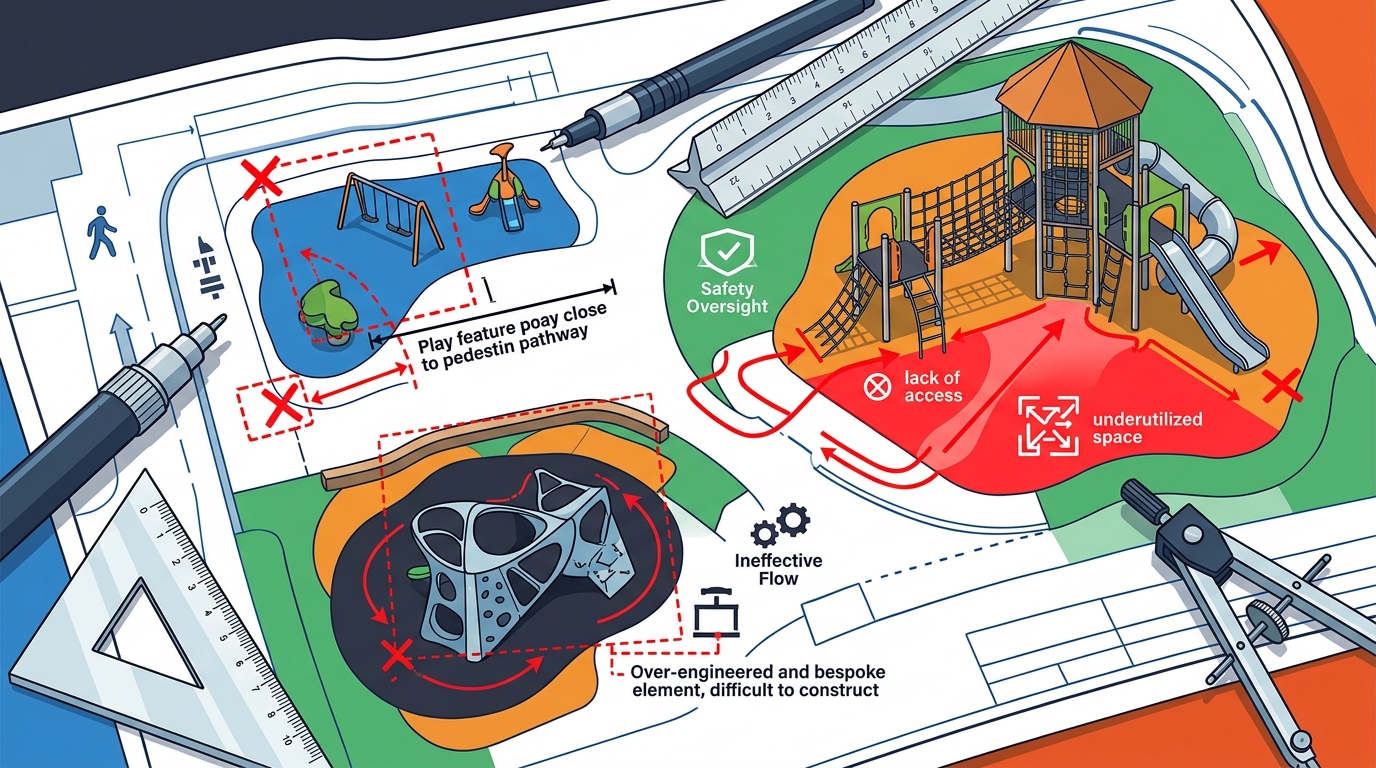
Designing a play area without a clear maintenance plan is a recipe for rapid deterioration. Many bespoke projects are designed with complex geometries or hard-to-reach components that make routine inspection and repair difficult and expensive. Preventative maintenance is the scheduled inspection and repair of play equipment to ensure ongoing safety and functionality. If designers do not consider access for maintenance crews, minor issues can escalate into major safety hazards.
Accessibility is also a key component of maintenance. If the surrounding pathways are not accessible, maintenance vehicles and personnel cannot reach the equipment efficiently. This leads to delayed repairs and increased long-term costs. Furthermore, the choice of surfacing materials impacts maintenance. Loose fill materials like wood chips or sand require frequent raking and topping up, whereas poured-in-place rubber or synthetic turf offers lower long-term maintenance but higher initial installation costs.
Another oversight is the lack of clear signage and user guidelines. Without clear instructions on age ranges and usage rules, the equipment is more likely to be misused, leading to premature wear and tear. Providing clear, durable signage helps manage user behavior and reduces the risk of accidents. For more information on maintenance best practices, see the maintenance guidelines provided by industry experts.
Ignoring Community Feedback
Perhaps the most significant mistake is designing in a vacuum, without engaging the local community. A bespoke play area is a public asset, and its success depends on how well it meets the needs and desires of its users. Community engagement is the process of involving local stakeholders in the planning and design of public spaces to ensure they reflect community values. When this step is skipped, the resulting space may be aesthetically pleasing but functionally irrelevant to the people it is meant to serve.
Local councils and developers often rely on generic templates or designer preferences, ignoring the specific demographic makeup of the area. For example, a neighborhood with a high proportion of young families may need more toddler-friendly zones, while an area with older children may require more challenging physical activities. Ignoring these nuances leads to underutilization and community dissatisfaction.
Engaging the community early in the design process can uncover valuable insights. Residents may have ideas for thematic elements, preferred equipment types, or concerns about noise and visibility. By incorporating this feedback, designers can create a space that fosters a sense of ownership and pride among the community. This approach not only improves the design outcome but also builds stronger relationships between developers and the public. For case studies on successful community engagement, explore Play England's resource library.
Design Approach Comparison
To help you understand the differences between common design approaches, the table below compares standard, compliant, and bespoke inclusive design strategies.
| Design Approach | Inclusivity Level | Maintenance Complexity | Community Engagement | Long-Term Value |
|---|---|---|---|---|
| Standard Off-the-Shelf | Low | Low | None | Low |
| Compliant Bespoke | Medium | Medium | Minimal | Medium |
| Inclusive Bespoke | High | High | Extensive | High |
Key Takeaways
- Inclusivity is Core: Designing for accessibility from the start prevents exclusion and expands the user base.
- Material Matters: Choose durable, climate-appropriate materials to ensure longevity and safety.
- Safety First: Strict adherence to safety standards and proper fall zone calculation is non-negotiable.
- Maintenance Planning: Consider long-term maintenance costs and accessibility for repair crews during the design phase.
- Community Voice: Engage local stakeholders to ensure the space meets actual community needs and fosters ownership.
- Expert Partnership: Work with experienced providers who understand the nuances of bespoke commercial design.
- Long-Term Value: Investing in high-quality, inclusive design yields higher community satisfaction and lower lifecycle costs.
Frequently Asked Questions
What is the most common mistake in commercial play area design?
The most common mistake is neglecting inclusive design principles, which results in spaces that are not accessible to children with disabilities or diverse needs.
How important is community engagement in play area design?
Community engagement is critical. It ensures the design reflects local needs, fosters a sense of ownership, and increases the likelihood of the space being well-used and valued.
What materials are best for commercial play areas?
High-density polyethylene (HDPE), powder-coated steel, and treated hardwoods are among the best materials for durability and safety in commercial environments.
How do I calculate fall zones for play equipment?
Fall zones are calculated based on the height of the equipment and the type of impact-absorbing surfacing used. It is essential to follow local safety standards, such as EN 1176, for precise calculations.
What is the role of preventative maintenance in play area longevity?
Preventative maintenance involves regular inspections and repairs to identify and fix issues before they become safety hazards, significantly extending the life of the equipment.
Can bespoke play areas be cost-effective?
Yes, while the initial investment may be higher, bespoke areas designed for durability and inclusivity often have lower long-term maintenance costs and higher community utilization rates.
How can I ensure my play area is safe for all ages?
Designing distinct zones for different age groups, using age-appropriate equipment, and ensuring clear signage and surfacing are key to safety for all ages.
Start Your Bespoke Project
Avoiding these common design mistakes requires expertise, experience, and a commitment to quality. At Jupiter Play & Leisure, we specialize in creating bespoke commercial play areas that are safe, inclusive, and engaging. With over 25 years of experience, our team works closely with clients to deliver innovative designs that meet the highest standards of play value and sustainability. Whether you are a local council, a private developer, or a community group, we are here to help you create a space that will delight and engage your community for years to come. Contact us today to discuss your project and discover how we can bring your vision to life.